Document Type : Review Article
Authors
1
Department of Chemical Engineering, School of Thermokinetic & Transport Phenomena, Amirkabir University of Technology (Tehran Polytechnic), Tehran, Iran.
2
Department of Chemistry, Amirkabir University of Technology (Tehran Polytechnic), Tehran, Iran
3
Department of Chemical Engineering, School of Thermokinetic & Transport Phenomena, Amirkabir University of Technology (Tehran Polytechnic)
10.22060/aest.2026.26512.1015
Abstract
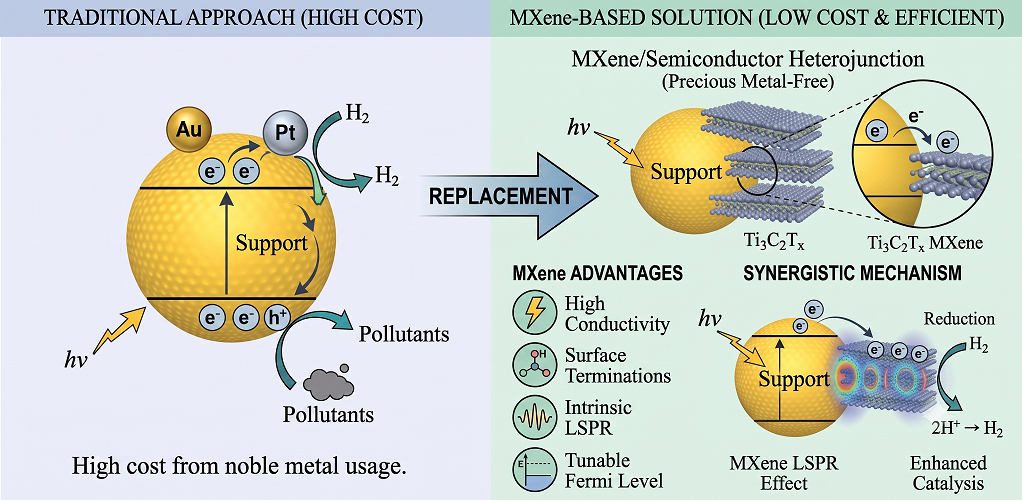
The intensifying worldwide energy crisis and significant environmental deterioration require sophisticated, sustainable photocatalytic technology for solar-to-chemical energy conversion. Conventional semiconductor photocatalysts often experience swift electron-hole recombination and constrained visible-light absorption, limiting their practical efficacy. In appropriately engineered MXene-semiconductor heterojunctions, these limitations can be mitigated through specific mechanisms that may operate individually or synergistically, depending on the system design: localized surface plasmon resonance (LSPR)-induced hot-carrier transfer, efficient charge extraction by the conductive MXene network, and Schottky-barrier-mediated spatial charge separation. This review clarifies that alongside their established role as conductive supports, certain MXenes subject to specific compositions, carrier densities, and morphological conditions can exhibit experimentally demonstrated intrinsic LSPR features within the visible and near-infrared (NIR) regions, distinct from ordinary broadband photothermal absorption. Furthermore, adjusting surface terminal groups (Tx) can modify the electronic structure and optical properties of these 2D materials, thereby influencing their overall plasmonic response. To address the inherent oxidative instability of MXenes under severe aqueous conditions, strategies such as fluorine-induced surface passivation have emerged as promising approaches to improve long-term photostability. We rigorously analyze sophisticated synthesis methodologies and their influence on thermodynamically challenging multi-electron reactions, including photocatalytic hydrogen production, carbon dioxide reduction, nitrogen fixation, and the mineralization of persistent pharmaceutical contaminants. By integrating robust 2D/2D heterojunction engineering with demonstrated plasmonic effects, MXene-based nanocomposites provide an efficient, highly tunable, and potentially noble-metal-free platform for advanced energy conversion and environmental remediation technologies.
Graphical Abstract
Keywords
Subjects